



























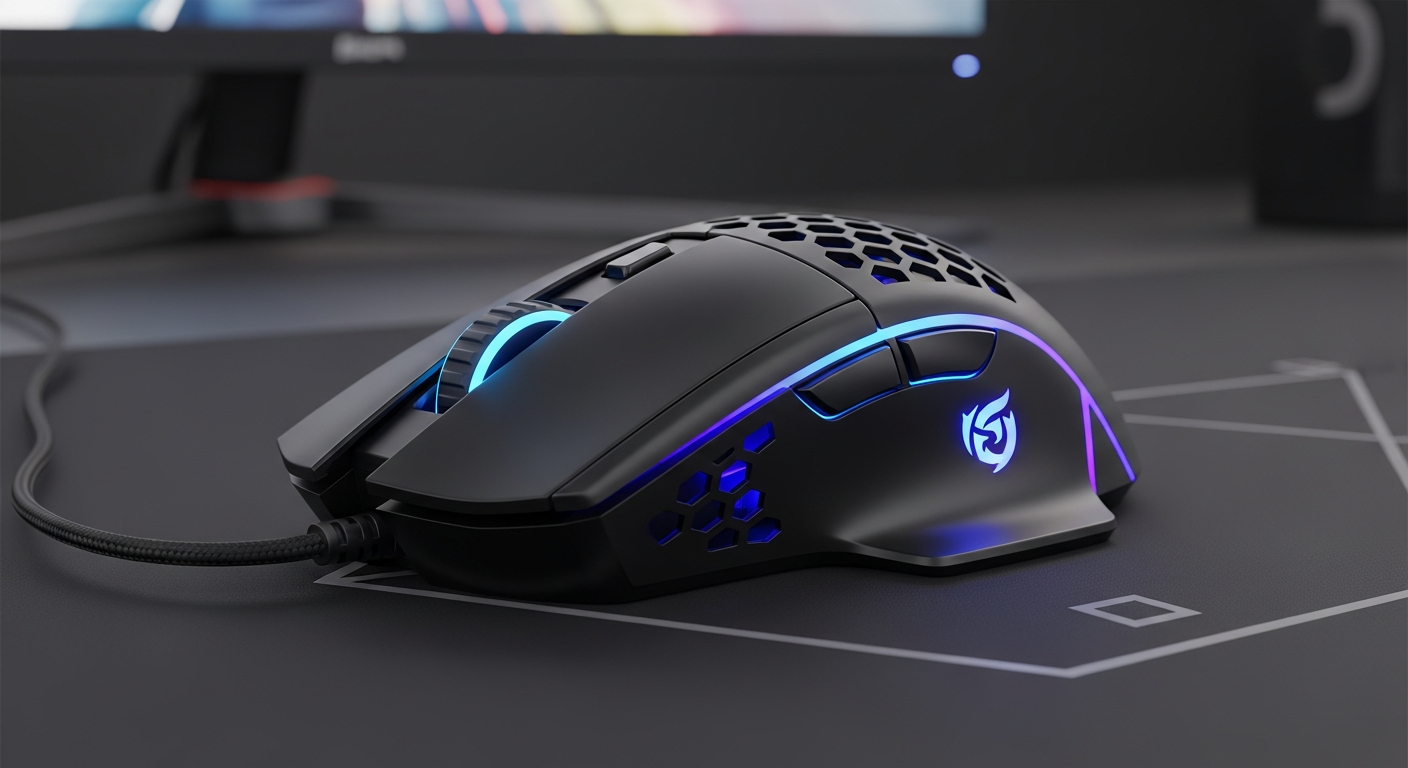
Alright, let's talk about something near and dear to my, and probably your, heart if you're reading this: esports. More specifically, the unsung hero of many a digital victory – the humble esports mouse. Now, you might be thinking, "A mouse? Really?" And I get it. It seems like such a small thing. But trust me, having the right rodent in your hand can be the difference between clutching that win and raging into oblivion. Okay, maybe not oblivion, but definitely frustration. And nobody wants that, right?
I remember when I first started taking PC gaming seriously. I was using some generic, office-grade mouse. It was fine for spreadsheets, sure, but for headshots? Absolutely not. The tracking was awful, the buttons felt mushy, and the overall experience was just… lacking. It wasn't until I upgraded to a proper gaming mouse that I realized what I had been missing. It was like going from driving a beat-up sedan to piloting a Formula 1 car. Maybe a slight exaggeration, but you get my drift.
But here's the thing, finding the perfect esports mouse isn't as simple as walking into a store and grabbing the flashiest-looking one. There are a ton of factors to consider, from sensor type to ergonomics to, well, how cool it looks on your desk. Let's dive in, shall we?
Decoding DPI and Sensor Tech for Your Esports Mouse
DPI (dots per inch) is one of those stats that gets thrown around a lot. Basically, it measures how sensitive your mouse is. A higher DPI means that the cursor will move further on the screen with the same amount of physical movement of the mouse. Now, a lot of people think that a super high DPI is always better, but that's not necessarily true. In fact, for most competitive games, you're better off with a lower to mid-range DPI. Why? Because it gives you more precision and control. Think about it: Do you really want your crosshair flying all over the place with the slightest twitch of your wrist? Probably not. I initially thought higher dpi means i can flick faster but that's not the case.
Sensor technology is also crucial. You've got two main types: optical and laser. Optical sensors are generally considered to be more accurate and consistent, especially on cloth mousepads. Laser sensors, on the other hand, can work on a wider variety of surfaces, but they can sometimes suffer from jitter or acceleration issues. For gaming, I'd almost always recommend an optical sensor.
Ergonomics: Finding the Right Fit for Your Hand
This is HUGE. You can have the most technologically advanced esports mouse in the world, but if it doesn't feel comfortable in your hand, you're going to be at a disadvantage. Think about it: You're going to be spending hours upon hours gripping this thing, so you want it to feel like an extension of your body, not a medieval torture device.
There are a few different grip styles to consider: palm, claw, and fingertip. Palm grippers rest their entire hand on the mouse, while claw grippers arch their fingers and only make contact with the mouse at the fingertips and the base of the palm. Fingertip grippers, as the name suggests, only use their fingertips to control the mouse. Choosing the right mouse depends on your grip style.
The shape and size of the mouse are also important. If you have large hands, you're going to want a larger mouse. If you have small hands, you're going to want a smaller mouse. And if you're left-handed… well, that adds another layer of complexity. Thankfully, there are some excellent ambidextrous options out there. And speaking of options, have you seen some of the wireless mice these days? Absolutely incredible. They've come such a long way in terms of latency and performance. But before you jump on the wireless bandwagon, let's talk about wired versus wireless.
Wired vs. Wireless: Is Cord-Free Worth It?
For years, wired mice were the only serious option for competitive gaming. The thinking was that wireless mice were too prone to lag and interference. But technology has advanced rapidly, and modern wireless mice are now just as responsive as their wired counterparts. In fact, many professional gamers are now using wireless mice. I’ve got to admit, this part fascinates me. The technology that allows a wireless signal to be just as fast as a physical cord is mind-boggling.
But there are still some advantages to wired mice. They don't require batteries, so you never have to worry about them running out of juice in the middle of a crucial match. They're also generally less expensive than wireless mice. And some people simply prefer the feel of a wired mouse. It really comes down to personal preference.
But one thing that's not up for debate is the importance of a good mousepad. I mean, you can have the best esports mouse in the world, but if you're using it on a wobbly table or a dirty surface, you're not going to get the most out of it. A good mousepad provides a smooth, consistent surface for your mouse to glide on, which can improve your accuracy and reduce fatigue. Check out the BGMI best tricks for more gaming tips!
Esports Mouse: Features that Matter
Beyond the basics, there are a few other features to consider when choosing an esports mouse. Programmable buttons can be incredibly useful for mapping complex commands or macros. Adjustable weight systems allow you to fine-tune the feel of the mouse to your liking. And RGB lighting… well, that's just for looking cool. But hey, looking cool is important too, right?
The frustrating thing about this topic is that there's no one-size-fits-all answer. The best esports mouse for you will depend on your individual needs and preferences. But hopefully, this guide has given you a better understanding of the factors to consider. Now go out there and find the perfect rodent for your fragging needs!
FAQ: Your Esports Mouse Questions Answered
How do I know if an esports mouse is actually worth the money?
Good question! Price isn't always an indicator of quality, but generally, you get what you pay for. Cheaper mice often use lower-quality sensors and components, which can lead to tracking issues and a shorter lifespan. A good esports mouse will feel solid, responsive, and accurate. Read reviews and compare specs before making a purchase. Also, consider the warranty – a longer warranty often indicates that the manufacturer has confidence in the product's durability. But remember, diminishing returns are real – a $200 mouse might not be twice as good as a $100 mouse.
Why is DPI so important on an esports mouse?
As mentioned earlier, DPI (dots per inch) measures the sensitivity of your mouse. While a higher DPI isn't always better, having the ability to adjust your DPI on the fly can be incredibly useful. It allows you to quickly switch between different sensitivity levels depending on the situation. For example, you might want a lower DPI for precise aiming and a higher DPI for fast-paced movement. Most esports mice come with software that allows you to customize DPI settings and assign them to buttons for easy access.
What's the deal with polling rate and how does it affect my esports mouse?
Polling rate refers to how often your mouse reports its position to your computer. A higher polling rate means that your mouse is sending data more frequently, which can result in smoother and more responsive tracking. Most gaming mice have a polling rate of 1000Hz, which means they report their position 1000 times per second. While a higher polling rate can be beneficial, the difference is often negligible, especially at higher DPI settings. As long as your mouse has a polling rate of at least 500Hz, you're probably good to go.
Is a wireless esports mouse really viable for competitive play?
Absolutely! As I touched on earlier, wireless technology has come a long way. Modern wireless gaming mice use advanced technologies like low-latency connections and adaptive frequency hopping to minimize lag and interference. In many cases, it's virtually impossible to tell the difference between a wired and a wireless mouse in terms of performance. Plus, the freedom of movement that a wireless mouse provides can be a huge advantage. Just make sure to choose a reputable brand and read reviews to ensure that the mouse has a stable and reliable connection.













![Peggle [FLASH] Game](https://gamerewardz.com/thumbs/peggle-flash-game_2.webp)