




























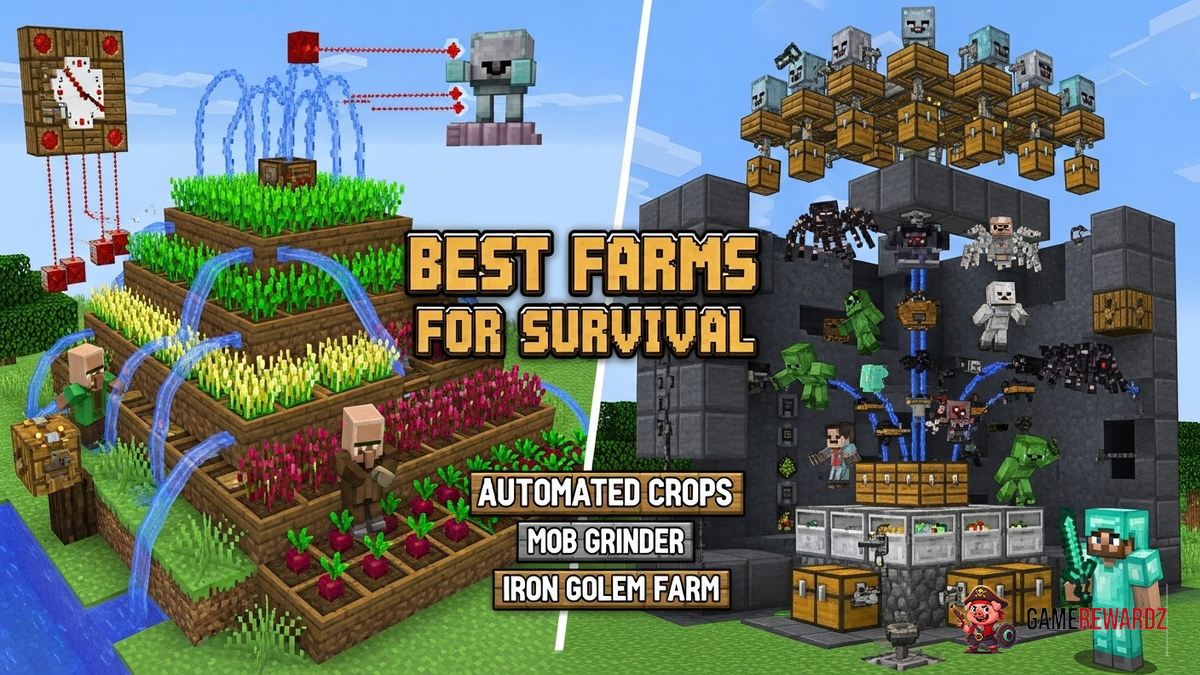
Okay, let's be real. Surviving in Minecraft without a decent farm setup? It's like trying to build a castle out of sand – possible, sure, but ridiculously inefficient and frustrating. You'll spend all your time hunting and gathering, leaving zero time for the fun stuff, like, you know, exploring those creepy caves or finally taking on the Ender Dragon. So, if you're serious about your survival world, you need farms. And not just any farms. We're talking about the best Minecraft farms for survival – the ones that'll keep your food stores overflowing and your inventory stocked with all the essential resources.
But here's the thing. There are a ton of farm designs out there. Some are ridiculously complicated, requiring hours of setup and enough redstone to make a circuit board blush. Others are just... well, underwhelming. So, how do you know which ones are worth your time? That's what we're diving into. I mean, who has time to waste building a farm that produces a single potato every hour? No one, that's who.
Think of this less like a tutorial and more like a conversation. I've spent countless hours building (and occasionally rage-quitting) various farms in my own survival worlds, and I'm here to share what's actually worked for me. No fluff, no overly technical jargon (as much as I can help it), just the farms that'll give you the biggest bang for your buck. And while you're strategizing your survival in the game, why not explore some fun titles at CrazyGames for inspiration?
The MVP: Automatic Food Farms
Let's start with the basics: food. You can't adventure on an empty stomach, and constantly hunting animals is just a pain. That's where automatic farms come in. My personal favorite for early- to mid-game is a simple wheat farm. Now, before you roll your eyes and say, "Wheat? How boring!", hear me out. Wheat is the foundation for so much in Minecraft. Bread, of course, but also cake (for those special occasions) and, most importantly, animal breeding. So, a steady supply of wheat is crucial. Here you can learn some amazing tips and tricks to progress faster in the game.
There are tons of designs out there, from simple water-based harvesters to more complex redstone contraptions. Personally, I prefer something in the middle. A water-based farm with observers to detect when the wheat is fully grown is relatively easy to build and incredibly efficient. The exact design depends on your available resources and redstone skills, but trust me, it's worth the effort.
But, wait, there's more! Don't stop at just wheat. Carrots and potatoes are also incredibly easy to farm automatically and provide a great source of food. Plus, potatoes can be cooked into baked potatoes, which restore even more hunger. Again, water-based farms are your friend here. Set up a few different farms for wheat, carrots, and potatoes, and you'll never have to worry about starvation again.
Iron Titan: Why You Need One (and How to Tame It)
Iron is the lifeblood of any Minecraft survival world. You need it for tools, armor, weapons, and countless other crafting recipes. Relying on mining alone is just not sustainable in the long run. That's where iron farms come in. Now, these can be a bit more complex to build than your basic food farms, but the payoff is enormous. We're talking stacks upon stacks of iron ingots every hour.
The basic principle behind an iron farm is exploiting the game's mechanics for spawning iron golems. Villagers, when sufficiently frightened, will spawn iron golems to protect themselves. By creating a specific setup with villagers, beds, and workstations, you can trick the game into constantly spawning iron golems, which are then automatically killed and their iron collected. Simple in theory, a bit trickier in practice.
There are countless iron farm designs online, and the best one for you will depend on your technical skills and available space. Some designs are compact and efficient, while others are larger and more complex but produce even more iron. I highly recommend watching a few different tutorials before settling on one. And don't be afraid to experiment! It might take a few tries to get everything working perfectly, but trust me, once you have a reliable iron farm, your Minecraft life will be forever changed. Speaking of change, don't forget to check out these ways to build games on Roblox.
Beyond the Basics: More Niche, but Still Awesome Farms
Alright, we've covered the essentials: food and iron. But what about those other resources that you need but don't necessarily want to spend hours grinding for? That's where these more niche farms come in.
Wool Farm: Sheep farms are surprisingly useful. Wool is needed for beds (obviously), but also for carpets (decoration!), banners (more decoration!), and trading with villagers. An automatic sheep farm is relatively easy to build using observers and shears. Just set it up, let the sheep graze, and watch the wool pile up.
Cactus Farm: Cactus is a surprisingly versatile resource. You can use it for green dye, compost, and even a rudimentary form of defense. Automatic cactus farms are simple to build using sand, water, and pistons. They're not the most efficient farms in the world, but they require minimal effort and provide a steady supply of cactus.
Experience (XP) Farm: Okay, this one is a bit more advanced, but it's incredibly useful for enchanting your gear. XP farms exploit mob spawners to generate a constant stream of enemies, which you then kill for experience orbs. There are many different designs, but my personal favorite is the classic dungeon spawner farm. Find a dungeon, set up a system to funnel the mobs into a kill chamber, and start racking up those levels.
FAQ: All Your Minecraft Farming Questions Answered
Why is my iron farm not working?
Ah, the age-old question! Iron farms can be finicky. The most common causes are incorrect villager setup (make sure they can sleep and work), insufficient workstations, or problems with the spawning platform. Double-check your design against a reliable tutorial and make sure all the requirements are met. Sometimes, simply reloading the chunk can also fix the issue.
How do I know if a farm design is actually efficient?
Efficiency is key! Don't just blindly follow a tutorial. Look for designs that have been tested and proven to produce a significant amount of resources in a reasonable amount of time. Read the comments on YouTube videos or forums to see what other players are saying about the farm's performance. And, of course, test it yourself! Time how long it takes to fill a chest with resources, and compare that to other designs.
What's the best way to transport items from my farms to my base?
Transportation is crucial for large-scale farms. Hoppers and minecarts are your best friends here. Use hoppers to collect items from the farm and deposit them into minecarts, which can then transport them along a track to your base. For long distances, consider using powered rails to speed up the minecarts. You can also use water streams to transport items, but this is generally less efficient over long distances.
Is it worth building a fully automatic sugar cane farm?
I get this question a lot, and here is my take. Sugar cane is used to make paper and is a key ingredient to craft rockets in Minecraft. While you can find this resource across the world, an auto farm is an ideal option to obtain great amounts of sugar cane easily.
Ultimately, the best Minecraft farms for survival are the ones that fit your playstyle and resource needs. Don't be afraid to experiment, try different designs, and find what works best for you. And remember, the most important thing is to have fun! Happy farming!












![Peggle [FLASH] Game](https://gamerewardz.com/thumbs/peggle-flash-game_2.webp)