
































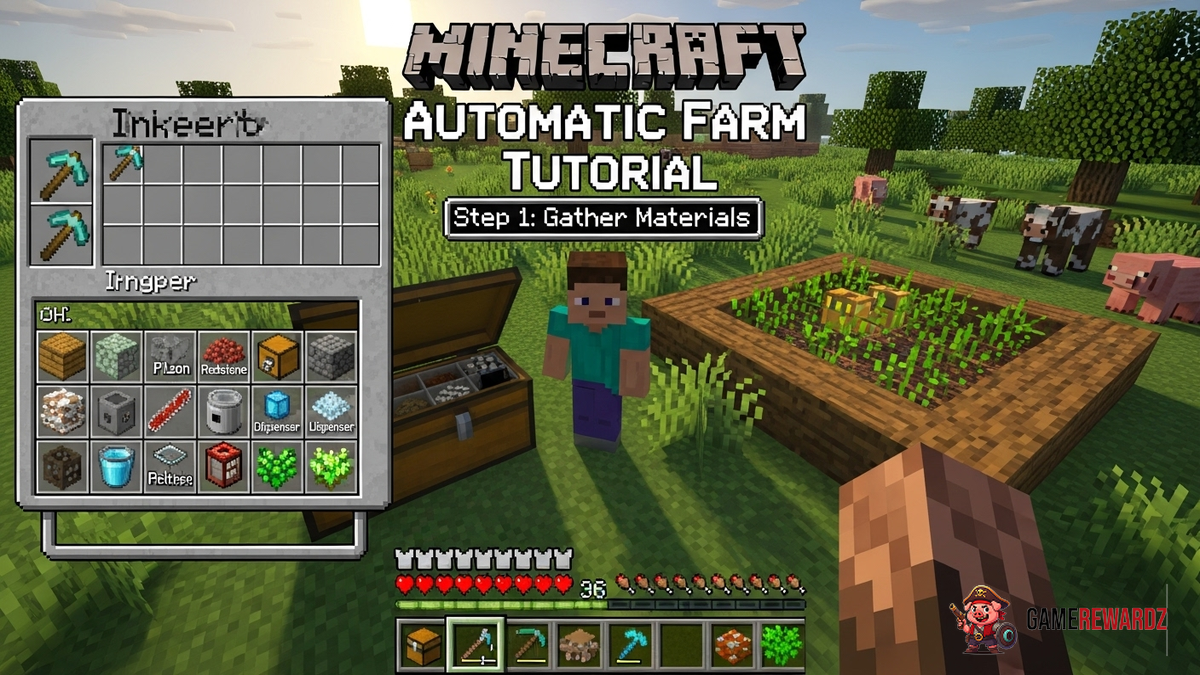
Okay, let's be honest. Mining in Minecraft? Soul-crushing after a while, isn't it? I mean, the first few diamonds are exciting. But then you need, like, stacks of wheat to keep your villagers happy, and suddenly you're spending your precious gaming time doing chores instead of battling creepers. That’s where automatic farms come in, and trust me, they’re game-changers. Seriously. And it's not as scary as it sounds – you don't need a degree in redstone engineering (though a basic understanding helps!). Let me walk you through it, with all the enthusiasm of someone who’s spent way too long automating their potato harvest.
Why Bother with Automatic Farms?
Think about it: Time is valuable in Minecraft. Do you really want to spend hours manually harvesting crops, when you could be exploring new biomes, building epic structures, or, you know, just hanging out with your friends? An automatic farm frees you up to do all that awesome stuff. Plus, they're incredibly efficient. You get a steady supply of resources without lifting a finger – well, maybe a finger to flick a switch. Here's the thing: Automatic farms aren't just about convenience; they're about optimizing your gameplay. Want to spend more time exploring? Focus on automation. It's simple, effective, and, dare I say, pretty darn cool.
But beyond the obvious benefits (less tedious farming!), there's a certain satisfaction in building a machine that just works. It's like creating your own little Minecraft factory. And let's not forget the bragging rights. Show off your impressive automatic farms to your friends and watch their jaws drop. It's a good feeling, trust me.
The Basics: Understanding Farm Types
Automatic farms come in all shapes and sizes, from simple crop farms to complex mob grinders. I initially thought that every farm needed to be a redstone masterpiece, but that's totally not the case. Actually, some of the most efficient farms are surprisingly simple. Here's a quick overview of some common types:
- Crop Farms: Wheat, carrots, potatoes, beetroot – the staples. These are usually water-based, using flowing water to harvest the crops and collect them in a central location.
- Animal Farms: Chickens, cows, sheep, pigs. These farms often use hoppers to collect eggs or other resources. Automation can be tricky, requiring some creative solutions.
- Mob Farms: Zombies, skeletons, creepers, spiders. These farms are designed to spawn mobs in a controlled environment and then kill them automatically, collecting their drops. These can get a little…dark.
And that barely scratches the surface! The specific design depends on the resource you're after and the biome you're in. But don't be intimidated. Start with something small and simple, like a basic wheat farm. You'll learn the principles, and then you can scale up to more complex designs. I remember when I first started, my wheat farm was literally just a dirt patch with water buckets... we've all been there!
Speaking of starting, for those who like a quick and easy option, you might want to visit Crazy Games, but building your own farms is much more rewarding.
A Step-by-Step Guide to a Simple Wheat Farm
Alright, let's get our hands dirty (virtually, of course). Here's how to build a basic automatic wheat farm. This is a great starting point for any budding Minecraft farmer. It's relatively easy to build and requires only a few basic resources.
- Prep your space: Choose a flat area and clear out any obstructions. A 9x9 area is a good starting size.
- Water source: Dig a 1x1 hole in the center and fill it with water. This will hydrate the surrounding farmland.
- Farmland: Use a hoe to till the dirt around the water source, creating farmland.
- Plant your seeds: Plant wheat seeds on the farmland.
- Water channels: Dig channels around the farmland, one block deep. These channels will be used to flood the farm for harvesting.
- Water release: Place a line of pistons along one side of the farm, facing inward. Connect the pistons to a lever or button.
- Collection point: Dig a pit at the end of the water channels, and place hoppers leading into a chest. This will collect the harvested wheat.
Now, when the wheat is fully grown, simply activate the pistons to release the water, which will wash the wheat into the collection point. Boom! Automatic wheat farm. Not exactly high-tech, but it gets the job done. This is a great base for expanding the farm by using the knowledge found on this site. From there, you can adapt the farm for other crops.
Redstone: Taking it to the Next Level
So, you've mastered the basic water-based farm. Now what? Time to dive into the wonderful (and sometimes frustrating) world of redstone. Redstone is Minecraft's equivalent of electricity, and it allows you to automate almost anything in the game. Seriously, anything. I've seen people build fully functional computers inside Minecraft using redstone. It's mind-blowing.
But for our purposes, we'll focus on using redstone to automate our farms. This might involve using redstone timers to automatically activate the water release, or using observers to detect when crops are fully grown. I've got to admit, this part fascinates me. There's something incredibly satisfying about building a complex redstone circuit that performs a specific task. If you're intimidated by redstone, don't worry. There are tons of tutorials online, and you can start with simple circuits and gradually work your way up to more complex designs. Experiment! That's the key.
FAQ: Your Automatic Farm Questions Answered
How do I know if my farm is efficient enough?
Efficiency can be measured in many ways, but the simplest is resources generated per hour. Compare your output to the time you spend maintaining the farm. If you’re spending more time fixing it than it saves, it’s time to redesign! Also, consider the resources invested in building the farm versus the resources it produces. Optimizing resource usage is key to efficiency in any Minecraft farm.
What's the most common mistake when building automatic farms?
Poor planning. Seriously. Before you start digging and placing blocks, take some time to plan out your farm. Consider the layout, the water flow, the redstone circuits, and the collection system. A well-planned farm is much more efficient and less prone to problems. Trust me, I've learned this the hard way. Starting with the end in mind is always a good way to go.
My automatic farm isn't working! What should I check?
First, make sure all your redstone circuits are properly connected and powered. Double-check the water flow to ensure it's reaching all the crops. Make sure your hoppers are connected to chests and aren't blocked. And finally, check for any stray blocks or mobs that might be interfering with the farm's operation. It could be a simple mistake that is the root of the problem.
Can I build automatic farms in the Nether or End?
Yes, but it's more challenging! The Nether has limited water sources and different mob spawning rules. The End has no natural water and is dominated by Endermen. You'll need to adapt your farm designs to these environments. For example, you might need to use soul sand to create water sources in the Nether, or build your mob farm high in the sky to avoid Endermen interference in the End. These are advanced projects, so get your Minecraft chops up to par before you try one of these.
Ultimately, building automatic farms in Minecraft is a journey of experimentation, learning, and, yes, a little bit of frustration. But the rewards – a steady supply of resources, more free time, and the satisfaction of building something amazing – are well worth the effort. So, go forth, build, and automate your way to Minecraft mastery! And remember, don't be afraid to experiment and try new things. That's how you truly learn and discover the endless possibilities of Minecraft.














![Peggle [FLASH] Game](https://gamerewardz.com/thumbs/peggle-flash-game_2.webp)