





























Okay, let's be real. Starving in Minecraft is just… embarrassing. You're supposed to be this legendary builder, tamer of dragons, conqueror of the Nether. And you're dying because you forgot to pack a snack? Nah, we can't have that. This isn't just a Minecraft Farming Guide for Unlimited Food; it's a path to Minecraft mastery. It's about taking control of your food supply and laughing in the face of hunger. Think of it as your personal, pixelated buffet.
I remember one time (this is embarrassing, but I'll share anyway), I spent hours building this elaborate castle, only to realize I was down to my last porkchop. And of course, there wasn't a single pig in sight. It was a dark time. I swore then and there I'd never be caught food-less again. And that's where farming comes in, my friends.
Farming? In Minecraft? I know, it might not sound as exciting as, say, battling a Wither. But trust me, a well-oiled farming machine is the bedrock of any successful Minecraft empire. A wise player once told me that the game has many different aspects but farming is the most important for survival. And he was 100% right. Plus, it's surprisingly satisfying to watch those crops grow, you know? It is truly magical.
The Basics: What to Farm and How
So, what are our options? Well, the classics are always a good starting point: wheat, carrots, potatoes, beetroot... You know, the usual suspects. Each has its pros and cons, of course. Wheat is easy to get started with (just whack some grass!), but carrots and potatoes can be replanted directly, which is a nice time-saver. And beetroot? Well, let's just say it's an acquired taste, both in real life and in Minecraft. It makes dye, and soup, so hey, don't knock it 'til you try it. You might also want to check this guide to get more insights about the game.
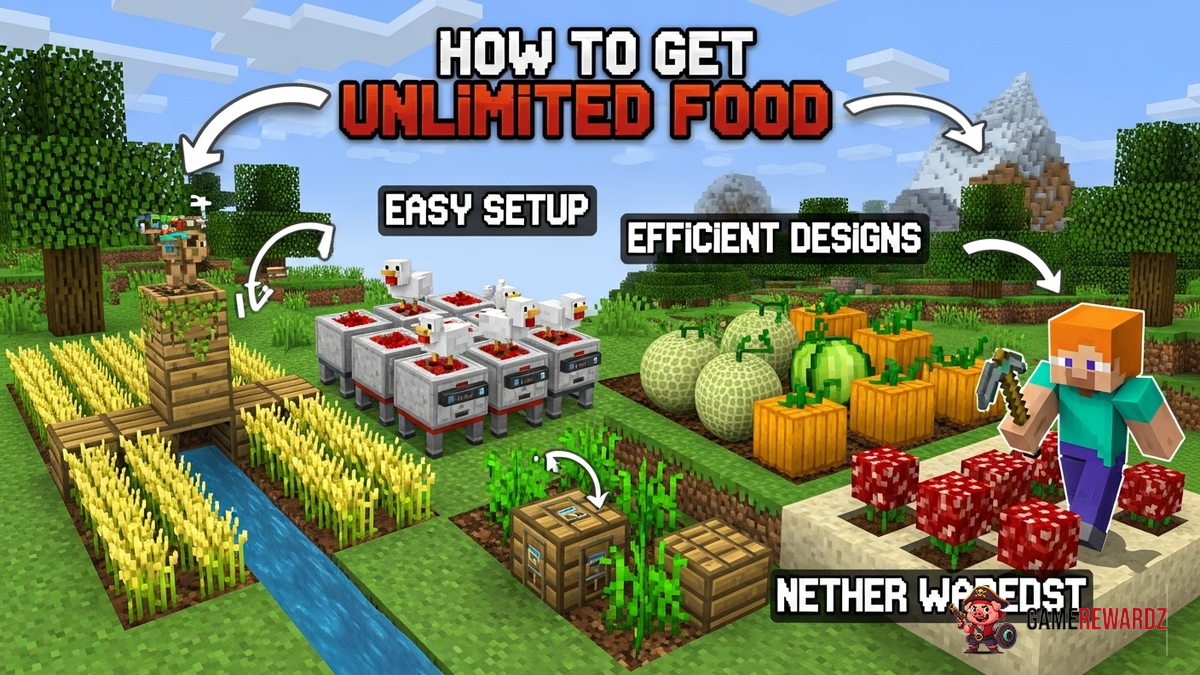
Here's the thing about farming in Minecraft: it's all about efficiency. You want to maximize your yield while minimizing your effort. The key? Water. Crops need water to grow, and the closer they are to a water source, the faster they'll grow. The standard rule is that hydrated farmland extends four blocks in each direction from a water source. So, plan accordingly. A simple 9x9 plot with a water source in the middle works wonders.
But wait, there's more! You might be wondering, “Is there a way to automate this?” Absolutely! That brings us to our next topic.
Automated Farming: Level Up Your Food Game
Okay, this is where things get really interesting. Automated farming is where you take your food production to the next level. We're talking about using redstone contraptions to harvest your crops for you. Sounds complicated? It can be, but it doesn't have to be.
The simplest automated farm involves using a water stream to push harvested crops into a collection point. You plant your wheat (or carrots, or potatoes) in rows, then use a piston to release a water source that washes everything away. The crops flow into a hopper, which feeds into a chest. Voila! Instant farm. Of course, it will need some work. I suggest you also read about the game at this resource to learn more.
There are more complex designs out there, involving observers, dispensers, and even villagers (those little guys can be surprisingly helpful). But start with the basics and work your way up. I've got to admit, this part fascinates me. The possibilities are endless! And remember, you can search for many more advanced tutorials on building automated farms to optimize your harvests.
Beyond the Basics: Advanced Farming Techniques
So, you've mastered the basics of farming. You've built an automated farm that churns out stacks of wheat every hour. What's next? Well, it's time to delve into the world of advanced farming techniques.
One important thing to consider is crop rotation. No, I'm not talking about real-life agriculture (although the principles are similar). In Minecraft, planting different crops in the same area can help prevent your soil from becoming depleted. For example, wheat is pretty resource intensive, but carrots and potatoes are less so. Alternating between them can help maintain soil fertility. Or, at least, that's how I like to think about it. Maybe I'm just making that up. But it sounds good, right?
And speaking of fertility, don't forget about bonemeal! Bonemeal is your best friend when it comes to accelerating crop growth. Just right-click on a crop with bonemeal in hand, and watch it sprout instantly. Of course, bonemeal can be a bit of a pain to acquire, but it's well worth the effort. You can get it by composting plant-based materials.
When trying to improve your farming, also consider linking your farms with villager trading posts. This is essential to getting rare resources.
The frustrating thing about this topic is that there's always something new to learn. New crops, new techniques, new redstone contraptions... It's a never-ending cycle of experimentation and optimization. But that's what makes it so fun, right?
FAQ: Your Minecraft Farming Questions Answered
How do I know if my farmland is hydrated?
The easiest way to tell if your farmland is hydrated is to look at the color. Hydrated farmland is darker than dry farmland. If your farmland is light brown and crumbly, it's not getting enough water. Make sure it's within four blocks of a water source.
Why aren't my crops growing?
There are several reasons why your crops might not be growing. First, make sure they're planted on farmland. Second, make sure the farmland is hydrated. Third, make sure there's enough light. Crops need light to grow, so make sure they're not in a completely dark room. Finally, be patient! Crops take time to grow, especially without bonemeal.
Can I automate the bonemeal process?
Yes, you can! There are several ways to automate the bonemeal process. One common method is to use a composter to turn plant-based materials into bonemeal, then use a hopper to collect the bonemeal and distribute it to your crops. It's a bit complicated, but it's well worth the effort if you want to maximize your crop production. Using the proper redstone builds, you can create a fully automated system.
What's the best crop to farm for food?
This depends on your needs and preferences. Wheat is easy to get started with and can be used to make bread. Carrots and potatoes can be replanted directly and provide a decent amount of hunger restoration. Melons and pumpkins can be grown in large quantities and are good for trading with villagers. Ultimately, the best crop is the one that you enjoy farming the most!
So, there you have it. Your ultimate guide to Minecraft farming for unlimited food. Now go forth and conquer your hunger! You can finally survive in peace.














![Peggle [FLASH] Game](https://gamerewardz.com/thumbs/peggle-flash-game_2.webp)