
















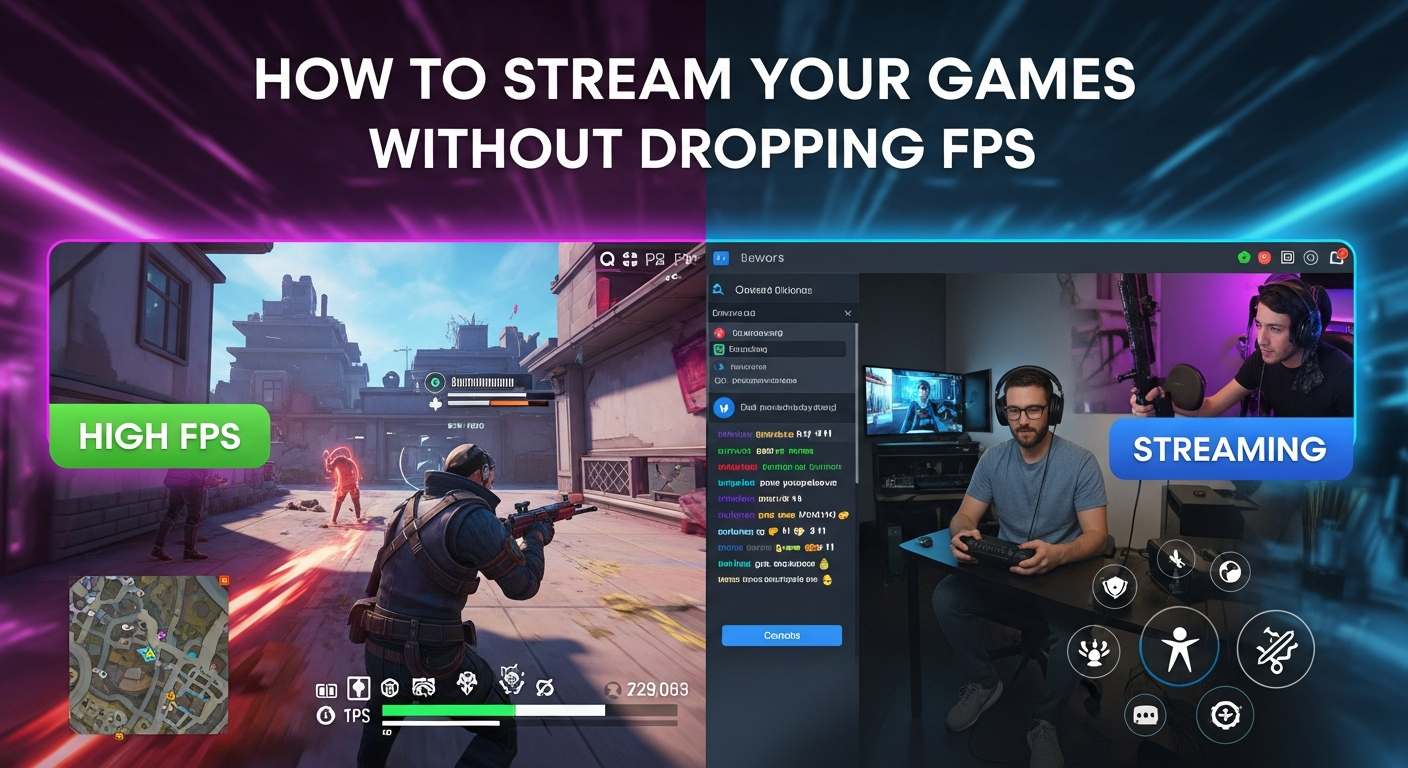
So, you wanna stream games, huh? Join the club! It seems like everyone's doing it these days, from screaming their way through horror games to calmly commentating on chess matches (yes, that's a thing!). But let's be real: nobody wants to watch a laggy, pixelated mess. We're talking smooth, buttery gameplay that makes viewers think, "Wow, they really know what they're doing." And that, my friends, is where maximizing your FPS comes in. Think of it as the key to unlocking streaming nirvana. I've been fiddling with settings and pushing my hardware to the limit for years, and let me tell you, there's a real art to getting it just right.
But before we dive deep into the techy stuff, let's address the elephant in the room. Why does FPS even matter for streaming? Isn't it just about, you know, playing the game? Well, yes and no. FPS, or frames per second, directly impacts the smoothness of your stream. The higher the FPS, the smoother the action looks to your viewers. A low FPS stream looks choppy and can be downright unwatchable. Imagine watching a fast-paced shooter at 15 FPS – it'd be like trying to watch a movie through a strobe light. Not fun.
Understanding the FPS Sweet Spot for Streaming
Okay, so what's the magic number? What FPS should you be aiming for when you stream games? The general consensus is that 60 FPS is the gold standard. It's smooth, it's visually appealing, and it's what most viewers expect these days. However, don't get hung up on hitting 60 at all costs. Sometimes, sacrificing a few frames for better overall stability is the way to go. A stable 30 FPS stream is often better than a choppy 50-60 FPS stream that constantly dips and stutters.
And here's the thing: it also depends on the type of game you're streaming. Slower-paced games like strategy titles or RPGs are more forgiving when it comes to FPS. Fast-paced shooters and racing games, on the other hand, demand a higher frame rate to look their best. I remember when I first tried streaming Apex Legends. My poor little CPU was screaming for mercy! It took a lot of tweaking to find a balance between performance and visual quality.
But it's not just about the game itself. Your viewers' internet speeds also play a role. If your audience is primarily on mobile devices with limited bandwidth, a super-high FPS stream might actually cause more buffering and lag on their end. It's a balancing act, folks. A delicate dance between your hardware, your game settings, and your viewers' internet connections.
Hardware: The Foundation of a Smooth Stream
Let's talk about the guts of your streaming setup. Your hardware is the bedrock upon which your streaming empire will be built. A weak CPU or GPU can be a major bottleneck, preventing you from achieving that coveted smooth stream. No amount of software tweaking can compensate for underpowered hardware. Think of it like trying to win a race with a bicycle against a Ferrari – you're gonna have a bad time.
Your CPU (Central Processing Unit) is responsible for encoding your stream, which is the process of converting your gameplay footage into a format that can be transmitted over the internet. A strong CPU is crucial for handling this task without bogging down your game. I've got to admit, this part fascinates me. Watching the CPU usage meter climb as I launch a stream is like watching a tiny little engine working its hardest.
Your GPU (Graphics Processing Unit), on the other hand, is responsible for rendering the game itself. A powerful GPU ensures that your game runs smoothly, allowing you to maintain a high FPS without sacrificing visual quality. It's like having an artist dedicated to making your game look its absolute best.
Now, I initially thought that a super-expensive, top-of-the-line CPU and GPU were the only way to achieve a smooth stream. But actually, that's not quite right. While powerful hardware certainly helps, it's not always necessary. With the right settings and optimizations, you can often get surprisingly good results even with mid-range hardware. It's all about finding the right balance.
Software Settings: The Art of Optimization
Alright, so you've got your hardware sorted out. Now it's time to dive into the software side of things. This is where things can get a little complicated, but trust me, it's worth the effort. Optimizing your streaming software settings can make a huge difference in your stream's performance.
The frustrating thing about this topic is the sheer number of options available. Every streaming software has its own unique set of settings, and figuring out what each one does can be a daunting task. But fear not! I'm here to guide you through the most important settings you need to know.
First up, let's talk about bitrate. Bitrate is the amount of data that's transmitted per second in your stream. A higher bitrate generally results in better visual quality, but it also requires more bandwidth from both you and your viewers. Finding the right bitrate is crucial for ensuring a smooth stream without causing buffering issues.
Next, let's talk about resolution. Resolution is the size of your stream in pixels. A higher resolution stream looks sharper and more detailed, but it also requires more processing power and bandwidth. Streaming at 1080p is generally considered the sweet spot, but if your hardware is struggling, you might need to lower the resolution to 720p or even 480p.
And finally, let's talk about encoder settings. The encoder is the software component that converts your gameplay footage into a streamable format. There are two main types of encoders: software encoders (like x264) and hardware encoders (like NVENC). Software encoders use your CPU to encode the stream, while hardware encoders use your GPU. Generally, hardware encoders are more efficient and can provide better performance, but it depends on your specific hardware.
Here's the thing: don't be afraid to experiment with different settings and see what works best for you. There's no one-size-fits-all solution, and what works for one person might not work for another. It's all about finding the right combination of settings that maximizes your FPS without sacrificing visual quality or stability. And don't forget to check out this guide on team building!
Beyond FPS: Other Factors for a Smooth Viewing Experience
While maximizing FPS is crucial for a smooth stream, it's not the only factor to consider. There are other things you can do to improve the overall viewing experience for your audience. Think about audio quality. Nobody wants to listen to a stream with crackling audio or a buzzing microphone. Investing in a good quality microphone and audio interface can make a huge difference.
And then there's your internet connection. A stable and reliable internet connection is essential for streaming. Nothing is more frustrating than a stream that constantly drops or disconnects. Make sure you have a fast and stable internet connection before you start streaming.
But it's not just about the technical aspects. Your personality and content also play a major role. Nobody wants to watch a boring stream, no matter how smooth it is. Be engaging, be entertaining, and be yourself. Let your personality shine through and create content that your audience will enjoy. Streaming is as much about entertainment as it is about technical prowess. So, show your enthusiasm, share your passion, and have fun!
FAQ: Stream Games Like a Pro
What if my FPS drops during intense gameplay?
This is a common issue! Try lowering your in-game graphics settings. Reducing the resolution, turning off anti-aliasing, or lowering shadow quality can significantly improve your FPS. Also, close any unnecessary programs running in the background that might be hogging system resources.
How do I know if my internet connection is good enough for streaming games?
Run a speed test! You'll need a decent upload speed, ideally at least 5 Mbps for 720p streaming and 10 Mbps for 1080p. A wired connection (Ethernet) is also much more stable than Wi-Fi for streaming.
Why is my stream still laggy even with high FPS in-game?
This could be due to your bitrate being too high for your internet connection or your viewers' internet speeds. Try lowering your bitrate in your streaming software. Also, make sure your streaming software is up to date.
Is streaming with one monitor impossible?
It's not impossible, but it's definitely more challenging! Switching between your game and streaming software can be a hassle. A second monitor makes it much easier to manage your stream, chat, and other tasks. However, if you're on a tight budget, you can definitely make it work with one monitor and some clever window management.
So, there you have it – a comprehensive guide to streaming games smoothly and maximizing your FPS. Remember, it's a journey, not a destination. There's always something new to learn and tweak. But with a little patience, a little experimentation, and a lot of enthusiasm, you'll be streaming like a pro in no time!










![Peggle [FLASH] Game](https://gamerewardz.com/thumbs/peggle-flash-game_2.webp)